

I want a dress.
I don't want a dress that comes above the knee
I don't want a tunic dress
I don't want a wrap dress
I don't want a smock dress
I don't want a sleeveless dress
I don't want a clingy dress
I don't want a shift dress.
In other words I want an A line dress with sleeves, and which hits just below the knee. Preferably not black.
But I think I'll go and look for the formula that turns base metals into gold, a cure for Aids and peace in the Middle East instead. No point chasing impossible dreams
Monday, 28 January 2008
Asking for the moon


Shopping in Egypt
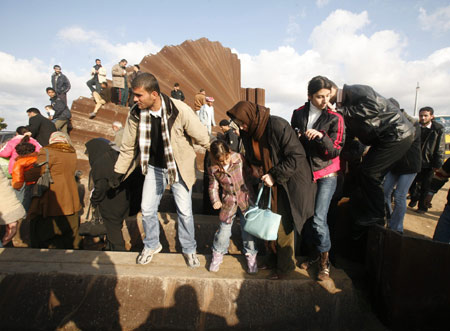
He climbed on board a pick-up truck, one of a dozen passengers wedged into the back, each paying 20 Egyptian pounds (£2) for what would have been a brief 20-minute drive along the main road. But to avoid the now frequent police checkpoints the truck took a tortuous journey along Bedouin tracks through the desert for two and a half hours. Twice the truck became wedged in the sand until Shuber, 30, and his fellow passengers got out to push.Once in El Arish he found, to his dismay, that the police had closed all the shops and restaurants in an effort to send the hordes of Palestinian shoppers home.
"I don't know where I'm going. I just came to have a look," said Shuber. "I was hoping to buy some electronics, maybe a food mixer for the kitchen or something for the children. But the prices have gone up and most of the shops are shut."
. . .
Some had put up with long and difficult journeys. Sara el-Masri and her son, Ahmad, 12, had been made to walk through the desert for three hours on Saturday to bypass the checkpoints. She returned only with a handful of gifts from a friend she had visited. "I wanted to come for the adventure. In Gaza we have nowhere to go," she said. "I just wanted to see something different."
Dark side of the moon
Hadley Freeman is on a roll this morning, explaining what exactly is wrong with polo neck sweaters, and why designers design so many clothes in black:

It's a sad truth, and one that I feel does our gender little credit, that so many women instinctively plump for black. Why, my sisters, why? Is this what we fought for, what we chained ourselves to railings for, what we burned some perfectly good bras for - to obscure ourselves in the colour of night, like Death Eaters from the world of Harry Potter? Good God, no. Surely a skating glance at any member from everyone's favourite Christian rock group, Evanescence, proves that black clothes against a pale visage do not an appealing image make. And lo, we have yet another example of what this column shall pithily call women-doing-something-that-they-think-will-make-themselves-look-better-only-in-fact-ending-up-looking- a-helluva-lot-worse (see also: dieting, wearing too small clothes or too high heels.)Because that, I fear, is why designers have, as you memorably put it, a Henry Ford mentality. It's not that they're so keen on black - if anything, they find it a bit of a drag because there are only so many black coats you can convince the masses to buy - it's just that they know it's the one shade that's guaranteed to sell. Break the bonds of fear, ladies, because the sad fact is that the only skin shade that makes black look good is, funnily enough, black, and occasionally brown. On everyone else, black makes them look anaemic or like a pretentious French philosophy student (bringing us back to Audrey Hepburn in Funny Face - circle of life, eh?) And while few people want to look pretentious, absolutely no one wants to look like a philosopher. Ewww!
Thought for the day
 Marguerite Duras by Avedon, 1993
People stop in amazement at the elegance of the foreigner who walks along unseeing. Like a queen . . . She's dressed in old European clothes, scraps of brocade, out-of-date old suits, old curtains, old models, moth-eaten old fox furs, old otterskins, that's her kind of beauty, tattered, chilly, plaintive and in exile, nothing suits her, everything's too big, and yet it looks marvellous. Marguerite Duras
Sunday, 27 January 2008
Voting in the Fabbies
The Fabbies are the first-ever, blogger-organized awards to recognize the top Fashion, Beauty and Lifestyle blogs from around the world. Various prestigious blog awards have existed for some time, but they repeatedly snubbed the Lifestyle Blogosphere, deliberately ignoring the growing power, influence and prestige of this group of bloggers. So, in typical entrepreneurial style, three bloggers decided to take action: The Manolo of Manolo's Shoe Blog, Tina Craig of Bag Snob, and Lesley Scott, Fashiontribes…with crucial assistance from Christina Jones of eBeautyDaily and Sam Francois of Papierdoll. One of the best features of the Fabbies is that it's a democracy. Rather than a few judges determining which blogs are "best" in 12 different categories (which showcase the impressive breadth and depth of the Lifestyle Blogosphere), it is the real experts – the blog readers, fans and supporters – that determine the winners with their votes, highlighting the deliciously freewheeling spirit of blogging. UPDATE You need to register on the site before you can vote.
After several technical glitches last weekend, the Fabbies have been relaunched. These are the fashion blog awards, and I'm delighted to have been nominated in the Best New Blog category, but there are many more to choose from. You can vote at the button on the right. If you voted last week, you may want to do so again on the redesigned site. The voting will be live through midnight GMT April 30, 2008. Here's what the organisers say:
Valentino on the model

"My dear, what can I tell you?" he sighs. "For a designer, models are never too thin, because when you have to present something in the right way, you are not obliged to see a full woman. It is like when a painter has an exhibition, the walls have to be white and perfect. For designers, when we present something, we don't want to be worried about proportion because the girl is too big or too fat."
Reader, she saved them
Today, in Britain it is Holocaust Memorial Day. There will be an event in Liverpool this evening. Jason Isaacs will be present.
The Observer has a remarkable little story of two British women who throughout the war wrote Mills and Boon romantic slush fiction, better known in Canada as Harlequin Romances in order to raise money to rescue Jews from the camps.
The mild-mannered spinsters became expert smugglers, regaling border guards with tales of the previous night's performance, switching labels in fur coats, and wearing real diamonds with outfits so dowdy that customs officers would presume the jewels were paste.
Desperate both to fund their trips and to assist refugees, Ida left the Civil Service and began as a romance writer, becoming one of Mills & Boon's most popular authors. For many decades after the war, Cook's writing supported her two passions: refugees and young opera singers. Her flat in Dolphin Square at various times housed homeless European families, Maria Callas and Tito Gobbi.
If you have a strong stomach, you can listen to the authentic voice of survivors recorded only a few days after the liberation of Belsen. It is the most eerie and disturbing recording I have ever heard.The sisters helped 29 people escape certain death, funded mainly by Ida's writing. In 1965, they were honoured as Righteous Gentiles by the Yad Vashem Martyrs and Heroes Remembrance Authority in Israel.
Desperately seeking vintage
For the past couple of months I have been working an on-going piece about the revival of the Ossie Clark label. The Observer today looks not only at the revival of Ossie Clark but his American counterpart, Halston.
While tycoon Marc Worth, founder of fashion information business WGSN, has funded the Ossie Clark London revival which kicks off on 11 February with a show at London's Serpentine Gallery, the team behind Halston is far more glitzy. Movie mogul Harvey Weinstein's Weinstein Company (TWC) bought the brand in a deal with private equity firm Hilco Consumer Capital, and Tamara Mellon, founder of the Jimmy Choo shoe empire, will oversee the relaunch, which starts with a show in New York on 4 February. Mellon will be helped by, among others, Hollywood stylist Rachel Zoe, who has dressed actresses including Demi Moore and Cameron Diaz. Jude Law is rumoured to be playing Halston in a forthcoming biopic produced by the company.
 Halston with party girls
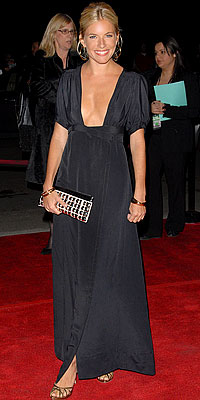 Sienna Miller in vintage Ossie Clark
The A-list interest in two labels from a bygone era is due to fashion's obsession with vintage clothing. Auction houses report sale prices of designer vintage have more than quadrupled in the past five years, and stores as diverse as high-street favourite Topshop and London's designer emporium Dover Street Market do a roaring trade in vintage clothing. Steven Philip, co-owner of London's top vintage boutique Rellik, said: 'Both labels spanned culture in a way that nothing has since. It's difficult to find another label that is associated with celebrities, clubs and music. Halston and Ossie conquered all three.' That affiliation endures today because stars who epitomise those values wear the labels. Kate Moss, Sienna Miller and Jennifer Anniston are regularly photographed in vintage clothes from these designers.
I don't know much about Halston, but having examined several Ossie Clark originals in the Islington atelier, what is evident is that they were designed by a man who knew something about the shape of a woman's body.
Thought for the day

Fashion must be the intoxicating release from the banality of the world. Diana Vreeland
Saturday, 26 January 2008
First review of The Clothes On Their Backs
 In the Saturday Times.
LINDA GRANT IS a writer of perceptive journalism about the emotional resonance of clothes, and now explores the theme in greater depth in her latest novel, The Clothes on their Backs. Her heroine, Vivien Kovaks, slightly resembles a rawer, angrier version of one of Anita Brookner's dutiful daughters, waiting in a tightly suppressed agony of longing for life to happen.
She is the child of elderly Hungarian refugee parents. Her father “suffered from an anxiety: that any small disturbance in his circumstances would bring everything down - the flat, the wife, the job, the new daughter, London itself, then England, and he would slide down the map of the world, back to Hungary”.
As a bulwark against such catastrophe, the Kovaks cling to the solid, red-brick respectability of their rented mansion flat in Benson Court, off Marylebone Road in London.
As a child, Vivien discovers occasional chinks in this stifling atmosphere of anxious conformity - in 1963, when she is 10, she witnesses a violent doorstep altercation between her father and a man claiming to be her uncle; a man in an electric-blue mohair suit, with a diamond watch on his wrist and a black girl on his arm. Later, there is a brief, delicious encounter with an elderly neighbour, a fragile old woman whose legacy to Vivien is a trunk full of improbably glamorous clothes - “silks, satins, velvets... a momentary rain of richness” - which will provide her passport to the world beyond Benson Court.
. . .
The Clothes on their Backs is a novel fascinated with how outward appearance at once conceals, expresses and forms the inner person.
Such is the richness of Grant's plotting that the story encapsulates many untold narratives - of Vivien's second marriage, for example, and her life with her two “fat, fair English” daughters - while the significance of other narrative threads can sometimes seem strangely opaque. But that is really the central theme of the novel - that life itself is opaque. You try to analyse it as best you can, but sometimes it is impossible to see past the surface of things.
from the Times, read on
Thought for the day

For your own sake you should give her a new gown; for variety of dresses, rouses desire, and makes an old mistress seem every day a new one. William Wycherley 1640 -1716
Friday, 25 January 2008
Unluckily for those of us who write fiction or poetry or plays for a living, the reading public’s demand that every scribbler become a “writer of conscience" has sunk its teeth into our butts. There are few demands for accountants of conscience, or orthopaedic surgeons of conscience. So what is it about novelists and poets that makes us qualified to analyse political trends and influence public opinion? The writer’s life consists of the following : staring in sick dread at a blank sheet of paper or Word document; typing something then deleting it; lying on the sofa daydreaming; staring out the window; making another cup of tea. Out of such banal conditions is literature made. Writers are foolish people who mistake their own interior worlds for reality, who exaggerate for effect, who believe they can make the truth sound better than it is in its raw form, and who feel their way clumsily in the dark , operating without a plan. Nonetheless, from time to time the writer turns on the television or reads a newspaper and discovers that wars are breaking out or that governments are about to be elected. Newspapers contact us to ask for our opinions. Are we for or against this war? How will we vote? We are flattered to be asked. The woman who runs the corner shop is not asked. Our bank managers are not asked. Our opinions must be of significance, and why not?
In the current issue of Prospect magazine, I have a piece on why novelists and poets of all people are expected by readers to be experts in geopolitics. The article has been hidden behind a subscription button but I now find it's been picked up by a South African newspaper called The Weekender.
Here is a snippet and read on

When you can only buy one thing, what should the one thing be

Thinking about the advice that a Valentino evening dress will last a girl forever, I am inclined to think that were I to spend a great deal of money on a single item, would it really be an evening dress?
The problem with spending so much on a statement dress is that if you wear it only five or six times a year, at grand parties (and I have far more use for cocktail dresses than evening dresses anyway) then whenever you go to a grand party, you will always be wearing the same dress. Back in 2000 I bought an evening dress at Liberty and wore it hard but finally it went to the charity shop for someone else to wear. I felt like every time I made an entrance, people were thinking, here she is, in that dress of hers. I haven't replaced it with another long dress, long having been out of style except on the red carpet for some years now.
In the Autumn, I saw an Armani Collezioni coat which made my heart stop. It was in my size and its price was £895 which I most definitely could not afford, having a couple of months earlier bought a Collezioni jacket. I didn't even dare try it on in case it stuck to me, as if I were a girl in fairy story, the cloth burning my skin. But if I had bought that coat, yes, I would have worn it for the rest of my life. Of course it would have to endure a few dark lonely seasons alone in the wardrobe, but out again it would come, eventually. If you can only buy one stand-out, knock-down, blow the overdraft garment, I'd buy something which can be accessorised. Something not made to be looked at but to make you look as if you have everyday elegance and style.
But don't let that stop you buying me Valentino dress.
UPDATE
Ten minutes later, I'm starting to think I'm being a bit boring and I should go for the Valentino dress after all. You only live once etc, and to walk into a room in a Valentino . . .
Why Armani is Armani

Jess Cartner-Morley, rounding up this week's couture shows, makes the following observation about Armani.

Giorgio Armani, although a relative newcomer to couture, is no slouch at making women look beautiful - which, after all, is the point here. Hilary Swank, in the front row, was in raptures, and it is easy to see why actors such as Swank and Cate Blanchett - women who play on having hard edges to their personality as well as softness, who have eyes that flicker and watch rather than just flutter beneath false lashes - are drawn to his gowns. The fabrics were pure couture princess: organza, puckered silk, chiffon muslin. But the silhouette, and the lines traced in bugle beads and Swarovski crystals, had a sleek, art deco Savoy-esque elegance.
The intelligent woman who also wishes to look beautiful, who cares about appearances and who understands that the body is not merely a wrap for the mind - the designer who can dress her (or shall we say us) will always outlive his flamboyant rivals .
Thought for the day
'What shall I wear?' is society's second most frequently asked question.The first is, 'Do you really love me? No matter what one replies to either one,it is never accepted as settling the question. Judith Martin (Miss Manners)
Thursday, 24 January 2008
Arrivederci Valentino

Last night’s show was filled with greatest hits — the narrow torsos, high busts, slim shoulders, feminine suiting and a spectacular finale of Valentino red evening dresses. It reminded everyone why Valentino outlasted all his contemporaries.
He did not over-license his name or succumb to drugs and certainly not to gimmicks. Fashionable but not fashion statements, classy but not dull, elegant but not stiff, a good Valentino evening dress will last a girl for ever. His successor, the Italian designer Alessandra Facchinetti, who was fired from Gucci, has a lot to live up to.
says Lisa Armstrong in the Times
I would like to do something serious, I don't say more serious than fashion

Valentino's final collection. The last great name from the Golden Age of Couture retires. And tells you what fashion is.
Watch the video

Thought for the day
Stars in the purple dusk above the rooftops
Pale in a saffron mist and seem to die,
And I myself on a swiftly tilting planet
Stand before a glass and tie my tie.
Conrad Aiken

Subscribe to:
Posts (Atom)